Thursday, 21 February 2008

Why Russia is right to feel the sky may fall in on its head

As you may have noticed, it has all gone a bit Battlestar Galactica in the world right now. Russian Strategic Nuclear Forces blog is the hero of the hour, for nuclear holocaust hobbyists and those playing catch-up alike. Just brilliant.

Russia understandably kicks off a storm because, for all the post-Soviet rearmament rhetoric, the Russian space program is not what it wants it to be. Also, the Russian nuclear ICBM targeting system is satellite-dependent of course. Ivan-Ivanovich has some nice big, shiny, glow-in-the-dark, new city-killers – all of which are absolutely useless if, suddenly, the forefront of big boys’ war really moves into space.

Because remember:

- 1.5 million men under arms is irrelevant given that every play-book on the planet assumes that military conflict with Russia goes nuclear within the first 24-hours
- And 1.1 million of those men are sullen conscripts of uncertain efficacy, maybe over 25% of which even the most optimistic Russian commander reckons are utterly useless

No military satellites = Russia left defenseless. That’s the simple, brutal truth.

IMHO, Russia *talks* anti-US/NATO threats to Russian territory, but this is misdirection. It is just simply incomprehensible that NATO would ever be the aggressor; even if Moscow bombed Tbilisi (which I think will happen, anyway).

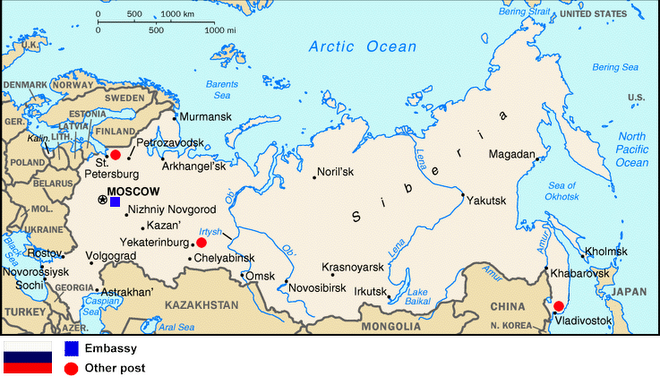
But China decides to invade east of the Urals? That is what the Kremlin really (rightly) fears, says I, one day hence. Russia is making way too much money out of the Chinese market right now to say so publicly, but it fears its eastern neighbour; just as the EU/NATO fears its, in turn. Why would China do that?

For China, finding fresh water is, by far, the biggest macro-political, or rather, civilization risk it faces. Oh yes – on just a “where is our fresh water” scenario – that has to be a meaningful statistical possibility that between now (OK, not 'now', but 'five minutes into the as-yet-unembraced future') and 2040 a desperate China seeing a demographically weak Russia just goes for land east of the Urals. And killing Russia's military saltellites is how they start to do it. Moscow knows that. This is what military planning is all about (and why it is so cool). You issue press statements attacking Washington DC, knowing Beijing gets the message too.

PS: What I heard last Friday, from a St Pete’s Siloviki clansman, in serious state employ, was 100% the complete opposite of the Moscow Times front page today. I shall – at risk of (more) ridicule – make this prediction: Mayor Luzhkov will retire by the end of 2008.

PPS: I posted before – actually, if I may say so within 8 hours of its release I think - about the Obama/YouTube song that may well be (wrongly) described in history as the zeitgeisty turning point in his campaign.

Don'tchajustluv this spoof? Pure, adulterated and wicked, splendid genius. I cried laughing:


PPPS: Apropos my last post, my long-suffering employer points out that, au contraire, in the event of crash-evac a private plane would have been guaranteed for me but, since “you are always prattling on in your blog about your fear of flying, we thought you would actually appreciate going overland! And - hello? - you’ve also blogged before about the wonderful security service we generously provide you”.

Point taken. They’re lovely. I'm indulged. Now feel like spoilt selfish git. Also must stop writing like male Bridget Jones. That ship may have sailed...

Tuesday, 19 February 2008

Another reason to remain cheerful about Russia

Yesterday a colleague emailed me:

“[the client’s] CEO was shot (but not killed) last week, so the [deal] is a bit postponed :( ”

(I think adding the emoticon is a nice finishing touch, don’t you?)

This one line email gave me a bit of a boost as:

- The guy lived, right?
- It has been ages since a client of mine has been shot; years in fact, which illustrates that the so-called Wild, Wild East is becoming a normal business environment just like everywhere else (oh yes! Brittle smile… )

In fact, this email came from our Kyiv office, which is an even more important reason to be cheerful for Russians therefore. No nasty shootings with our Russian clients, oh no! But in touchy-feely, oh-so-democratic Ukraine? Um… business-by-bullet is still occasionally an issue there.

Probably there is no more eloquent testimony to President Putin’s success in bringing order and safety to Russia than the fall in the numbers of (intentional) corporate killings. And when it happens, it’s screamed from the front pages and everyone is very shocked. Actually I bet business-by-bullet is more common in the USA than here…

PS: the actual story of who shot the client and how, is… er… very funny, but there is no way I can repeat it here. Just suffice it to say long-liquid-lunches and an Uzi-semi don’t mix: as ‘props’, to make a point in a post-lunch debate, they are more ruinous than rhetorical.

Actually, come to think of it, our ‘track record’ is pretty good here. Racking my brains I don’t think we’ve lost anyone ‘on-the-job’/client-wise due to corporate hits; excluding, a tad before my time, an incident in Georgia.

There, I think, the client CFO was murdered and we instigated, for our people, a ‘crash-evac’ (as one past employer of mine called them); or fast extraction. You know the drill: beefy body-guards, armour-plated fast cars, private plane… Damn! Very cool…

Well, at least that is how a previous employer conceptualized the process. Not sure about my current one though (bus timetable and overnight train to Finland is perhaps more likely if trouble came my way… and I would have to buy the bus ticket).

Other than "shots fired!" (a shoot-out by my chauffered-Merc) in Kazakhstan, in the 1990s’ aluminium wars – advice that day to me from then British Ambassador: “We cannot guarantee your safety and we recommend you leave the country. Today please, if you can.” - and lock-down / petrol bombs in Haiti, my life has actually been rather sadly suburban.

Although there was the anonymous delivery of a ‘black silk mourning’ tie to my office on my arrival – just weeks after I shafted a well-known Russian oil company on a big deal in Turkey – and a petrol-bombing in my elitny street, one summer’s night. But, hey, that happens everywhere, right?

Favourite word of the day? ДЕМШИЗА – Demshiza; a nice mélange of democrat and schizophrenic. It’s what United Russia-types call the pro-Kasparov loons. Seemingly, with cause.

Sunday, 17 February 2008

Awaiting the grim certainty of revenge

(The Cartoon above – and elsewhere in this post – is from the Opinion page of the London Daily Telegraph. This is from 14th February; spoofing a movie poster seen in London right now).

Tonight, with gunshots into the air, Kosovo declared independence. I wish this pseudo-State, or its people, no harm. But I do not welcome it. As I have said before, I supported maintaining the territorial integrity of Serbia. As I type this there is sporadic, maybe even half-hearted, rioting outside the US Embassy in Belgrade.

Of more consequence will be Moscow’s response. On the face of it, this is a major (and personal) foreign policy failure for President Vladimir Putin, some will say. Personally, I think that harsh: the die was cast in the last, chaotic months of the Yeltsin misrule. By the time VVP had established internal order in Russia, the Russian state was far too behind, with too few moves, to succeed in the Balkan game.

But there will be a response from Moscow, all the same. Just weeks from the electoral coronation of his handpicked replacement, President Putin, will take deeply, red-mistly, personally the West’s united ignoring of Russia’s voice. If only for his personal sense of dignity, the Russian President will demand a price is paid. Recognizing the independence of Abkhazia and South Ossetia – and thus fracturing Georgia – is just the start of it. Personally, I think it gives more impetus to create a second USSR, starting with the integration of Belarus and Russia; and the incorporation of Abkhazia and South Ossetia.

The grandstanding President Saakashvili of Georgia – never knowingly under-exposed on CNN this one – will mewl and howl over the airwaves; but in truth no-one will take a single meaningful step to stop Russia if it does this. Who would be so stupid? OK, so the Harry Potter of global diplomacy might be; this would not surprise me. I suspect things will be become clearer in March. Revenge being a dish best served cold and all that…

Can anyone tell me what was up in central Moscow this weekend? After four years here I am used to random deployments of troops, but there were just so many in town this weekend. Taking the Tverskaya underpass from the Actor’s Gallery to home, there were about 50 Militia conscripts herded under here, soaking up the warmth. In their super-padded blue jackets, these boys (who all looked about twelve), momentarily appeared to be the hybrid offspring of a teletubbie and a smurf. However, around the corner from my street were two truck-loads of OMON. Now these dead-eyed, muvver-fukkers get my repect. I have no doubt they would disembowel their firstborn, if so ordered by the Chekists.

It has been a weekend when I am very conscious of the few ‘touching points’ between Russia and the west right now. There are few certainties to hold on to and I sense something nasty coming our (expat) way. At the top of my blog, it says my life is a ‘slalom’ between the politics of east and west. And this is increasingly true.

While they all pretend to be too sophisticated to be duped by it, the slow drip-drip of state media poison has noticeably changed the way my staff relate to the idea of the west (other than a place to shop and vacation; which they all do with enthusiasm).

Just a week ago, one young staffer emailed the office an offhand comment about ‘western companies raping Russia’ – this from a lad whose salary, all paid 'white', with health insurance etc, has more than tripled in three years. We’re the firms raping Russia? ‘Cos all those oligarchs have done so much for the well-being of their fellow-citizens…

Next time I get a lesson in Russian patriotism from him I must remember to ask when he is planning to fulfill his conscription duty…

Then, a couple of nights ago one of my senior staffers emailed me (about UK-Russian relations): “Give me a break! We've always been enemies and will remain enemies. Even Americans are much closer to us than Brits.”


To which I felt the need to reply:
"Oh. Fuck off dearest mate [he's one of the few staffers I would call a mate and he knows I swear at him with English Middle-class, fruity affection].

"That’s balls, as even the briefest consideration would remind you, it was the USA that murdered the USSR in the Afghan war. The UK just provided tea and crumpets for that dispute.

"Like most Russians, you are still beguiled to think that Britain is your enemy because you have read too much ‘Great Game’ nonsense (and the televised novels of Boris Akunin).

"That said, like the Roman Empire, both Russia and the USA are two ‘empires’ whose sole raison d'être has been that the state serves a primarily military-elite. You are right: the USA and the post-USSR are the same: and as D H Lawrence (a good socialist, and anti-communist and hero of mine) once so memorably put it: “between the two blades of that pair of scissors, we shall all be cut to bits”.

A political friend in London – reading over this exchange -sagely reminded me of what Lord Palmerston said: “Nations have no permanent friends or allies, they only have permanent interests.”

The anti-western, default thinking of Generation Putin is becoming more deeply entrenched and is not going to go away. Those western governments and analysts who think the risks of a sabre-rattling bear reduce with Putin exit stage left? Completely misreading, they are, the changes in Russian society.

To cheer myself up, though, I have spent the afternoon downloading, from iTunes, digitally re-mastered arias by some of the great, now sadly dead, sopranos. And in my head is a civilized, safe place, where no-one can get me.

Thursday, 14 February 2008

The current market rate for bribes in Russia – an English translation – and Russia: has it got the power?


I had a staffer put this together for me today (posted alongside); the current (alleged) tariff for bribery in Russia (overall I think it is 15-20% light of real costs, but that is IMHO, so there).

Across my screen today I also saw a Deutsche Bank piece:

Electricity and heat supply outages across Russia
Deutsche Bank

February 14, 2008
There have recently been a number of accidents across the country resulting in temporary electricity and heat supply outages. Interfax reports that an equipment failure at the Carevskaya power substation in the Astrakhan region led to the electricity supply for almost 36,000 people being interrupted. Separately, the Krasnoyarsk governor blamed poor maintenance works at Eniseiskaya TGK for a number of failures in heat supply this winter, Interfax reports. There was also a fire at CHP-1 (TGK-14) in Ulan-Ude.
In our view, nearly all these accidents were the result of more than a decade of underinvestment in the sector [Exile's emphasis]. However, thanks to privatization and the liberalization of the sector, a significant amount of money has been raised for capex needs in almost all of sub-sectors. Nevertheless, such accidents highlight the technological risks of the sector and as most of the grid's and generation equipment is worn out, we cannot exclude there being further outages in the future. -1-140208

Heretofore, Anatoly Cubais’s great ‘unbundling’ of the Russian power monopoly has made middle-ish management, of variable talent (variable, because some are world-class), rather staggeringly rich. It is to be seen if it will be remotely effective in keeping Russian lights or furnaces burning bright (let alone Moscow AirCon systems running cool in summer) in the years to come.

Although not presently (yet) directly a fee-related interest, I am following the Russian GenCo-Distribution systems carefully (I cut my industrial-political teeth, as a lobby-ling, on the European gas and nuclear power sectors).

In 2009, I think one of the more conceptually interesting IPOs will be Inter RAO: the electricity trading arm of the dying behemoth, RAO UES. As I have written for someone elsewhere (not on the web), hydro-power from Kyrgyzstan, grid-linked to Russia, looks a good PPP/PFI investment bet. Ditto, strategic partnerships for foreign firms in the GenCo sector, prepared for an ‘RPI+/-x’ long-term-like concession.

Indeed, if Europeans can put aside their mono-dimensional bleating about ‘energy security’ for just a tiny moment, they will see (as I write in one of those rather dry, slightly neo-con-ish, US geo-political journals next month):

‘Energy security is a two-way street. Although we think of Russia as an exporter of oil and gas it is, and will increasingly become, an electricity importer. Over the three electricity Russian IPOs/privatisations we have worked on [in 2007] during the break up of the RAO UES monopoly, we see how truly inter-connected Europe’s energy markets and energy best interests are.

“Russia’s own electricity needs mean that it is already importing electricity from Kazakhstan; and shortly will import – in scale – hydro-electric power from Kyrgyzstan. The RAO UES subsidiary, INTER RAO (itself a likely IPO candidate in, perhaps, 2009) is the fascinating business that imports all this power, and looks enviously at the possibility of importing electricity from the generators of Central Europe; if only it can raise the billions of Euros necessary to build the inter-connecters between Russia and the CEE nations [Exile: which is now the reason why Gazprom is looking to buy European GenCos -they are buying Russia’s energy security for 2015+ ].

“So let us all conclude that energy security is a two-way street: raw materials in one direction and electricity in the other. In fact, in any debate concerning energy security it is good to remember that very few people come to the debate objectively and without an agenda. The EU institutions want to control one of the largest aspects of the EU combined economy, national sovereign determination of which member states have jealously guarded. Russia is frequently criticised but perhaps should do more to put forward its own case.”

As is unfathomably often the case for hydrocarbon-rich countries, Russia is hydrocarbon rich, but electricity poor (the same is true, BTW, for Saudi Arabia, Iran, Venezuela and even Kazakhstan).

And in Russia, this electricity ‘poverty’ is really beginning to show. This is an area that takes more than six months’ central pump-priming, highly visible, Kremlin investment to cure. Not least as, for Russia, GenCo infrastructure is only part of the challenge. It’s the ‘wires’ and the sub-stations too: now that’s fiddly and relatively expensive to do and… er… becoming really quite vital to medium-long term, Russian economic vibrancy.

PS: understand this sector and you see that Kazakhstan’s interest in buying some of Westinghouse is, actually, very, very clever.

The price of doing business here?

After a great weekend in the North of England, which was looking wonderful in uncharacteristally bright Spring (?) sunshine, I came back to flu and have been in bed asleep for most of the last two days. I don't know what they put in Russian Coldrex, but Damn! it is good.


While I have been asleep, a colleague forwarded me the table here, which appeared in Vedomosti on Monday. The article and table is about the current going rate for bribes people have to pay to do business here in Russia. The original article, in Russian, is here (and the table is more legible if you click on the link in the article).

But the point is: $250,000 for proposing a law (yeah, but a good $1-2 mill to get it passed mate); a 30-40% cut for commercial participation in one of the Priority National Projects; $20,000 retainer to TV news for criticism of targeted bureaucrats; etc. These are allegedly the going 'market rates' for bribery presently. They feel about right to me.

Although, in my experience (anecdotal, natch), TV news editorial-judgments are becomming a lot more expensive than that; and to get your man spotlighted positively on one of the main Russian current affairs programs? $150-200k I am told.

Although, oddly, this sort of thing has never crossed my path directly; from what I am hearing bribery rates have gone up for Russian businesses recently, as the current ruling elite are looking to... ahem...monetarize their experience, just in case political change will follow Medvedev into the Kremlin. As has been written well elsewhere, there may not be much of a democratic race on in Russia at the moment; but the clan wars amongst the Siloviki are as hard-fought as anything right now between Obama and Hilary.

This story about the market for bribery, did remind me of the depressing front-page lead in the Moscow Times yesterday, on the rise of 'raidering' in Russia. Now generally, 'raidering' is something I associate with Ukraine, where it is rampant. I had thought it was on the wane in Russia; and I think it is in the larger corporate sector; and not something I think will greatly affect western businesses. But it does, on the other hand, provide more ammunition for those who would say that Russia has become a state which exists by, for and of the modern-era Chekists. And, to the extent that anyone serious about doing business in Russia needs to have employed at least one seriously-well connected ex-KGB/FSB officer, I guess I reluctantly agreeing.

Thursday, 7 February 2008

Something for the weekend

So now I am off to the UK, family business, and this is what I have packed for my weekend reading:

- “Continuity in Russian regions: How ‘Operation Successor’ is working in key regions and what it means for international investors - Tatarstan” – and note I have finally learned how properly to spell Tatarstan in the Roman alphabet!
- “Distributed Influence – Quantifying the impact of social media” - an Edelman white paper
- “A power audit of EU-Russia relations” – a policy piece from the European Council on Foreign Relations, one of its co-authors is Mark Leonard. He and I once got cautiously drunk, as I recall, at a Labour Party annual Conference - 1996 or 1997; in Blackpool or Brighton (they all merge into one hideous memory)
- “Social costs of smoking and the impact of tobacco excise duties”; an academic study from Hungary (!) – it comes with a handy second volume of Excel spreadsheet data
- “Value at the bottom of the pyramid” (a refutation of ‘common misconceptions about doing business with low-income consumers’) - from the IE Business School in Madrid.

And I wonder why there is so little joy in my life… LOL!

Wednesday, 6 February 2008

Off topic: Stamina required! But then, On Topic, Russian economics

Since the man who is going to win the Russian Presidential Election, by a landslide, doesn’t really feel the need to campaign, I wanted to post some personal observations about Super Tuesday, since it is the only electoral ‘race’ I am going to witness this year.

As the Democrats seem set for a long-drawn out slog to determine their candidate three factors will become increasingly important.

Money talks: after an initial barn-storming start the Clinton campaign has been slower to raise money; whereas Obama has drawn in millions in the last three months. Using CNN’s last quarterly data, it looks as though Clinton should be pretty safe; but in the last six weeks, Obama has raised more healthily than she. Hillary Clinton did better than ‘Big Mo’ predictions (including mine) suggested; and this may help to shake the money tree some more for her. But in a long campaign for the nomination, Obama may be advantaged by the fact that he will be able outspend Clinton in the later stages of this race.

Clinton as at end Q4 2007 (CNN):


Obama as at end Q4 2007 (CNN):


This Democrat desperate spending spree is great news, BTW, for the Republican nominee, come the… you know… actual General Election.

Lack of downtime can lose elections: I have personal experience of this! The Democrats may find they do not have a clear winner by the end of May. This is a disaster for the party! There is every chance that, when we get to the Democrat Convention (Denver, August), it will be a ‘brokered convention’. The eventual nominee will be exhausted – mentally as much as physically. Meanwhile, the Republican candidate – looking more likely to be McCain – will have had a good 2-3 three months to rest (no need to campaign while the Democrats are still slugging it out) mentally and physically, and hone their national campaign message. Hate Bush as many US citizens do; there is now a growing possibility that McCain can beat Clinton, and I think even more likely, Obama, either of whom may both enter the race weakened.

Money talks here too. As the Democrats soak up more and more cash from their wealthy backers for the Primaries, that necessarily presents an opportunity cost for the General.

The White stuff : Early break-out stats suggest Obama is gaining white votes – and how sad that this should be a factor – but he is still to break 40% of white voters in the Democrat primaries to date. Again, this is good for the Republicans. Especially if McCain – once he has the nomination – campaigns on a ’50-state’, more centrist strategy. The Right will hate this, but they will fund it rather than see Obama in the White House.

US voters enjoy balancing the ticket – one party for President and another for Capitol Hill. I think the odds of a McCain one-term Presidency, albeit with a Democrat-led Senate and House, are looking shorter.

PS: Exile says Huckabee for President in 2012; because even if he can do it, McCain can only be a one-term President. And Huckabee’s knee-capping of the Romney campaign yesterday? That must have earned him the VP-slot in a McCann candidacy (nicely delivering the South as it does too – and keeps Anne Coulter-types off of McCain’s back).

Russia today? Nada caught my eye except: rotten inflation stats for January and a shrinking current account surplus; with RenCap forecasting the current account surplus will fall to zero by end 2009. Like I have said before; supply-side economics are out of kilter with domestic demand and 1-2 years from now, the Russian government is finally going to wake up to this fact, against generally weaker commodity prices: which is 1-2 years too late. As we enter 2010, ‘cheap money’ in Russia is going to be hard to find; the major western economies will still be weak and so where will inward investment in Russia come from then?

Does any of this matter? LOL! Maybe not. But put it this way. If I was the head of a global hedge fund, on a quarter-to-quarter view? I would now be overweight Russian stock to the global equity index I use and would increase my tolerance to Ruble exposure.

But, if I was global chief investment officer of a pension fund? I would be looking at a structural position underweight Russian equities, compared to the global index I use, and much less tolerant of RUR exposure, over the medium term. And, yes, I might be buying some more gold.